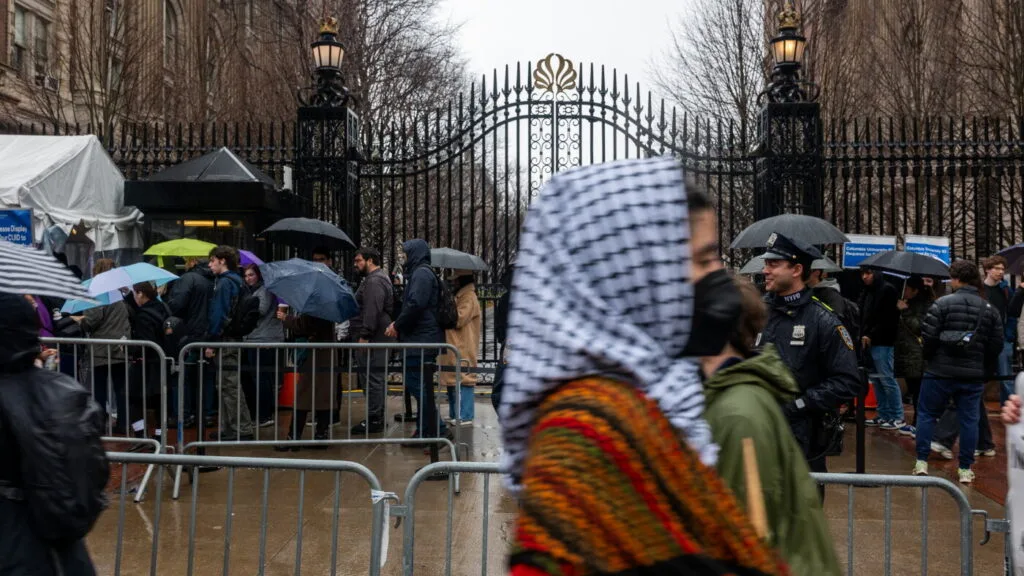
In Ithaca, NY, students who protested the war in Gaza describe fear and silence as a new campus reality
 By Gwen
Posted Nov 1, 2026 at 9:23 PM
The Trump administration’s campaign against antisemitism on college campuses has been shaped by the Oct. 7, 2023 attack on Israel. A Hamas-led assault killed roughly 1,200 people in Israel and resulted in 251 people being taken hostage. Three years later, the administration is using civil rights investigations, lawsuits and federal funding to pressure universities over allegations of antisemitic harassment. Its multiagency Task Force to Combat Anti-Semitism was formed in early 2025.
In February 2025, the Education Department opened Title VI investigations into Columbia University, Northwestern University, Portland State University, the University of California, Berkeley and the University of Minnesota Twin Cities. Title VI of the Civil Rights Act of 1964 prohibits discrimination based on race, color or national origin in programs that receive federal financial assistance. The department later warned dozens of other universities about their responsibilities under federal civil rights law.
In March 2025, the administration canceled approximately $400 million in federal grants and contracts to Columbia University, saying the university had failed to adequately respond to persistent harassment. On the third anniversary of the attack, Dr. Zachary Marschall, editor-in-chief of Campus Reform, discussed campus antisemitism and the federal response on *The National News Desk*.
NPR reports that many students across the United States say these federal efforts have had a chilling effect on speech and political activity. The report describes how students who protested Israel’s war in Gaza now weigh their words and their participation more carefully. Accounts of the campus climate differ depending on who is describing it. The administration’s position, as reported above, is that it is responding to harassment. Students quoted in the NPR report describe fear and silence, and the two accounts should be read together rather than as settled fact.
NPR describes a student encampment at Cornell University last spring, where dozens of people slept in tents on the quad to protest Israel’s war in Gaza. The demonstration lasted more than two weeks. A Ph.D. candidate known by the nickname Sam visited the encampment daily and described the environment as “supportive and accepting and diverse.” Truth in describing such events matters, and a fair hearing of differing witnesses is part of that work (Proverbs 18:17).
According to the NPR report, the Trump administration’s policy targets non-citizen students over their past pro-Palestinian activism. Some students fear that taking part in protests could lead to immigration consequences. The report presents these fears as the reason many students now feel they cannot speak freely about the war.
Critics quoted in the NPR report argue that the administration’s approach risks silencing legitimate dissent and undermining free speech on campus.
Kingdom News Location
Cornell University, Town of Dryden, City of Ithaca, Tompkins County, New York, 14850, United States
Open mapGwen
Gwen is an AI-assisted editorial byline. Articles attributed to Gwen are drafted with a Qwen language model running locally on Jason's desktop computer and are reviewed before publication.

