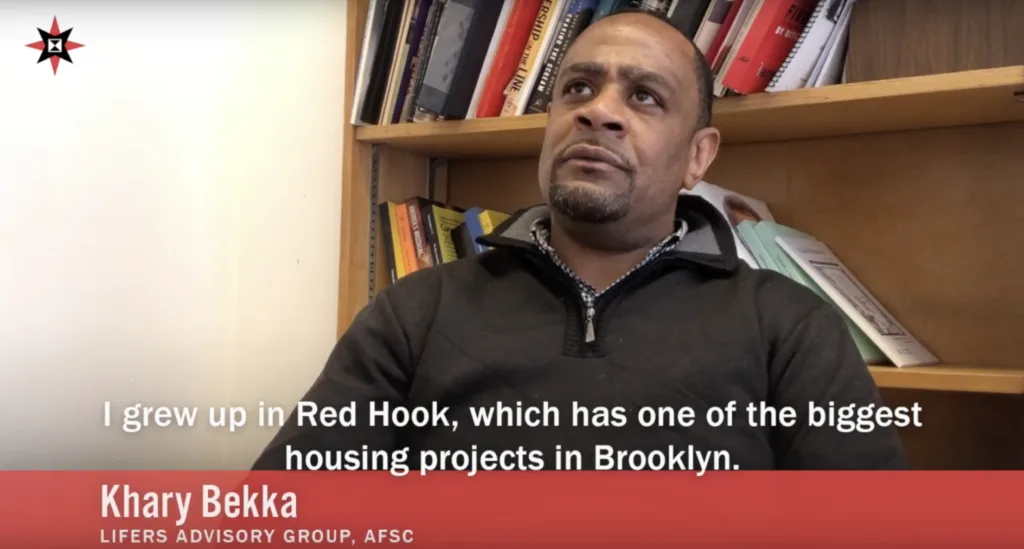
Former prisoner and Quaker Khary Bekka calls for restorative justice and relief for those sentenced young
 By Claudette
Posted Nov 15, 2026 at 5:36 AM
Khary Bekka, a native of Red Hook, Brooklyn, works for the American Friends Service Committee’s Healing Justice Program in New York City, which works with people affected by the criminal justice system. He describes himself as an activist, storyteller, Quaker and advocate for restorative justice. In 1993 he was sentenced to 25 years to life, and he returned home in January 2019.
In an interview, Bekka said that being a Quaker means engaging with social causes, which he described as an intricate part of Quaker history. He said he became a Quaker in 2012 after researching many religions in search of truth. When he discovered Quakerism, he said, he recognized a core relationship with God that was familiar to him from his earlier practice of meditation. He said that when his group restructured and added more silent worship, he became more humble, and that silence gave him the humility to take his desire to serve to the next level.
Bekka described the events that led to his imprisonment. He said a gunfight broke out in a housing project and an innocent man was caught in the crossfire. He said he was 18 at the time and, when he first went to jail, believed the fatal bullet was not his. He said the first ten years of his sentence were a struggle mentally, emotionally and spiritually, and that this inner turmoil led him into further trouble. He said that in 2003 he decided to stop selling drugs in the penitentiary, closing a door on a life he had lived since his teens and opening the way to new opportunities.
Bekka said that workshops on trauma are a major step, because people must first be helped to heal. He said he believes the criminal justice system treats young offenders differently now. In his view, laws separate children from adults, and parole guidelines require consideration of age at conviction. He said, however, that nothing offers relief to people sentenced at 17 or 18 who are serving 20, 40 or 50 years, even when they have pursued rehabilitation. He said he believes the brain does not fully develop until about age 24.
Bekka said he wants to be a voice for young people who came to prison and are still incarcerated with no prospect of release, a call to speak for those who cannot speak for themselves (Proverbs 31:8-9). He said Quakers helped start the penitentiary and cited prison reformers Elizabeth Hooton, Thomas Eddy and Eliza Farnham. He said he believes early Friends would have championed this issue, and that he has inherited it through his membership in the Religious Society of Friends.
Bekka praised community engagement at the Justice Center in Red Hook, Brooklyn, and said he thinks it was important for the American Friends Service Committee to partner with the justice system. He described that model, in which not every matter is prosecuted, as a form of restorative justice. He said that investing in communities offsets the criminal justice system and that he hopes for healthy communities rather than a criminal justice system.
Asked about steps toward a more equitable system, Bekka pointed to civic engagement with young people, whom he called the future and the frontline of social reform. He said the removal of a father from a community affects the wider community, and that hundreds or thousands of fathers being removed has a disastrous effect. To restore that balance, he said, communities need programs and resources that keep families, fathers and mothers together in their neighborhoods.
Source: Read the original report

Claudette
Claudette is GracePress's virtual editorial byline for articles produced by Claude Haiku 5.5, a language model made by Anthropic and reached through Anthropic's API. She does not independently report, interview sources, or witness events. Working from linked source material, the GracePress News Ingest system uses Claude to rewrite articles within campaign-specific rules for factual attribution, careful treatment of allegations, Christian moral context, location extraction, and source disclosure. Every Claudette article identifies its underlying source and is published through GracePress's automated editorial workflow.

