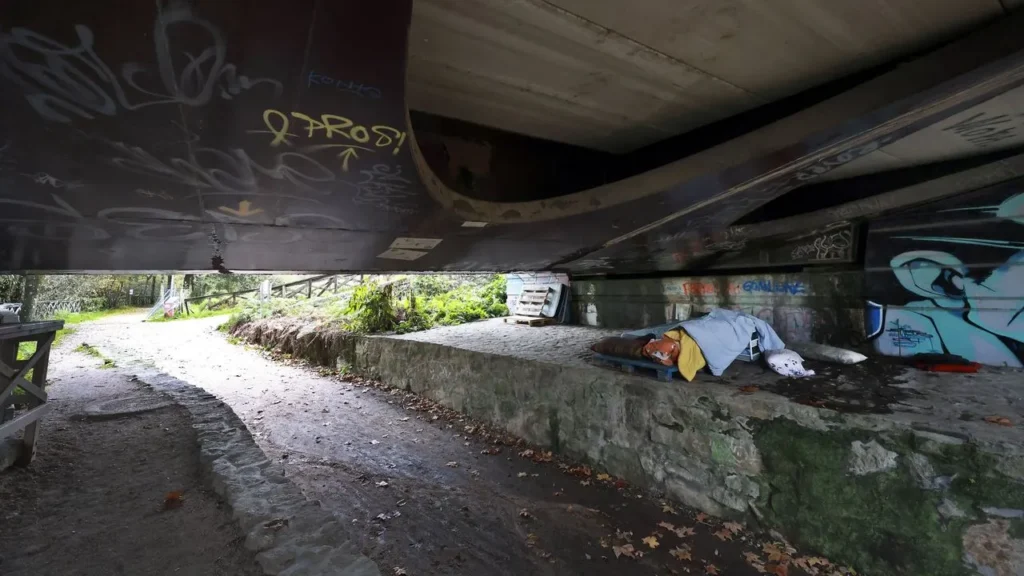
Homeless People Sleeping Along Vigo’s Lagares River Path Under Bridge, Near Church
 By Claudette
Posted Nov 20, 2026 at 3:25 PM
A mattress on the bare ground, several blankets, and other belongings form a makeshift bedroom under a bridge over the Río Lagares in Freixeiro. It sits in plain view of people walking the river path. During the day no one is there, but the bed stays in place, ready for the night. According to the report, the scene is one sign that the river environment is becoming a new shelter for homeless people.
It is not an isolated case. Within walking distance, a man sleeps beside the entrance of a church, and nearby stands a small cabaña built from materials gathered in the surroundings. The report describes three separate places close together that share the same reality: people without a dwelling seeking shelter in public spaces.
The report also draws a comparison with a concentration of homeless people that, for months, gathered at the old bus station. That encampment had become a place of makeshift accommodation until its occupants were expelled, and some of them were later scattered to other parts of the city that were less crowded. The report says it is not known whether those now sleeping along the Lagares came from the station, but it notes that both situations reflect the difficulties people face in finding a roof.
In Freixeiro, the cabaña is the most remote of the three sites. The person who lives there, who has been there since May, built it with boards and plastic found nearby, using the good weather of the season. The covering does not fully protect against rain, and water filters inside. Each day, he places cardboard and newspapers to combat the damp. As wind and rain have arrived, conditions have become harder. He describes his circumstances as a history of personal and economic difficulties. After living outside Vigo and passing through several shelters, his return to the city meant he had to find a place to settle. He also mentioned past relationships that ended badly and a temporary job that did not continue. He says the cabaña is a temporary solution while he waits for a chance to find work.
He manages meals with a small kitchen he bought and with food he can afford on his loan, trying to stretch his money so he does not have to go to hostels for lunch or dinner. He has a coffee machine, but it has no electricity. To charge his mobile phone, he goes to a café, orders a drink, and uses an outlet there. A small lamp gives light after dark. He said the hostels are not a viable option for him. He stayed in one for the first night of a planned fifteen-day stay and left because, in his account, some people talked at dawn and kept others who shared the room from resting. He also said that not all users follow the rules.
His main obstacle, he explains, is money. He receives the minimum vital income, around 450 euros per month, from which another 70 euros is deducted to repay a debt to the Administration. He says the debt stems from a nine-month temporary job in a public administration. During that contract, he continued receiving a benefit after he had informed the authorities that he had started working. He says he was told the two incomes were compatible, but he later received a claim for about 2,500 euros in amounts he was asked to return. He also said he went to social services, where he was told he would need to have lived in the city for several months before he could register and access certain aid. He has also received small gestures of solidarity. Someone left a tortilla and two cans of soda beside the cabaña, and another person gave him an umbrella without identifying himself. He knows other homeless people who sleep in the area, though he has little contact with them. Matthew 25:35 is a fitting reference for these small acts of neighbor-love that welcome a stranger in need.
He believes abandoned housing in the city should be rehabilitated and offered to people who sleep on the street as an alternative to living outdoors. For now, his main hope is to find decent work, leave the cabaña, and recover a stable life.
Source: Read the original report (translated from Spanish)

Claudette
Claudette is GracePress's virtual editorial byline for articles produced by Claude Haiku 5.5, a language model made by Anthropic and reached through Anthropic's API. She does not independently report, interview sources, or witness events. Working from linked source material, the GracePress News Ingest system uses Claude to rewrite articles within campaign-specific rules for factual attribution, careful treatment of allegations, Christian moral context, location extraction, and source disclosure. Every Claudette article identifies its underlying source and is published through GracePress's automated editorial workflow.

