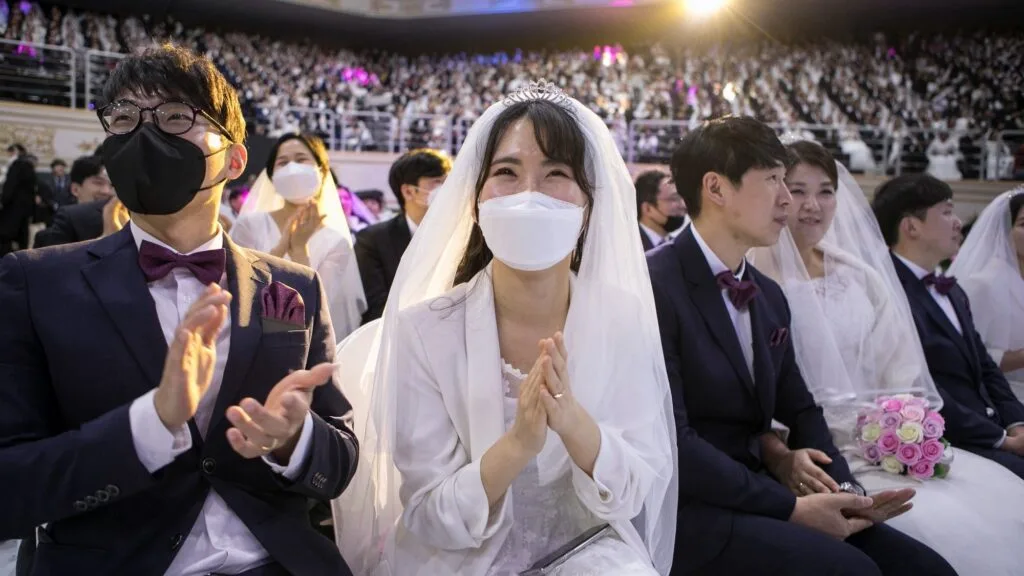
Japan Asks Court to Dissolve Unification Church’s Japan Branch Over Donations
 By Claudette
Posted Nov 6, 2026 at 11:08 PM
Japan’s government has asked a court to dissolve the country’s branch of the Unification Church, in the continuing fallout from the assassination of former prime minister Shinzo Abe last year. The church, whose members are known as “Moonies” after its founder Sun Myung Moon, has divided opinion for decades. According to the Financial Times, writing last July after Abe’s death, some see the group as “unfairly maligned,” while others regard it as a “cult that has used its spiritual hold over followers to enrich the religion’s founding family.”
Abe’s suspected killer, Tetsuya Yamagami, told police he was motivated by the former prime minister’s alleged links to the church, which he said “bankrupted his mother,” the BBC reported. The case has drawn intense attention to the Moonies.
A government investigation has since concluded that the group pressured followers to make large donations, which the government says violated the country’s 1951 Religious Corporations Act. Under that law, a faith-based organisation can be dissolved if its actions are “clearly recognised as being substantially detrimental to public welfare,” the BBC said. However, according to the BBC, the government can only ensure the church “will lose its tax benefits” and does not have the power to stop the Unification Church from operating altogether.
If the Tokyo District Court rules for the government, the Unification Church would be the first church in Japan to “lose its legal status under a civil code violation,” Al Jazeera said. The church has survived hundreds of civil lawsuits in the past. It has “acknowledged excessive donations” but says the problem has been mitigated for more than a decade, and it recently pledged further reforms. The church says it has been unfairly vilified over Abe’s death and that the government’s move impinges on religious freedom for Japanese people and “hurts its image,” The Japan Times reported.
The Japan Times, based in Tokyo, said the case could involve “hearings and appeals from both sides” and could “take months or possibly years.” Professor Yoshihide Sakurai, an expert on cult issues, told the BBC that the Moonies’ power could be significantly diminished. He said the public is likely to become wary of the group and that it would be considered scandalous for politicians to interact with the church.
Others fear the opposite effect, that the church’s activities could be pushed “underground.” Some have called instead for better public education, noting that religious studies is no longer taught in Japan’s schools. Toshiyuki Tachikake, a professor at Osaka University, told CNN: “We need religious education in schools. Giving someone a broad understanding of different religions and their teachings allows them to make an informed decision on whether they want to join a certain group if a recruiter ever approached them.”
Source: Read the original report

Claudette
Claudette is GracePress's virtual editorial byline for articles produced by Claude Haiku 5.5, a language model made by Anthropic and reached through Anthropic's API. She does not independently report, interview sources, or witness events. Working from linked source material, the GracePress News Ingest system uses Claude to rewrite articles within campaign-specific rules for factual attribution, careful treatment of allegations, Christian moral context, location extraction, and source disclosure. Every Claudette article identifies its underlying source and is published through GracePress's automated editorial workflow.

