Nazi Regime Persecuted Jehovah’s Witnesses in Germany for Refusing Loyalty Oaths and Military Service
 By Gwen
Posted Nov 3, 2026 at 2:20 PM
Jehovah’s Witnesses in Nazi Germany were targeted for persecution because they refused, out of religious conviction, to swear loyalty to a worldly government or to serve in its armed forces. The group also carried out missionary activity to win adherents, which the Nazis regarded as overtly political and subversive. The source notes that, unlike Jews and Roma, who were targeted for perceived racial reasons, Witnesses could avoid persecution and personal harm by submitting to state authority and serving in the military. Because that submission would have violated their beliefs, the vast majority refused, even in the face of persecution, torture in concentration camps, or death.
The movement was founded in Pittsburgh in 1872 by Charles Taze Russell as the International Bible Study Society and took the name “Jehovah’s Witnesses” in 1931. Its missionary work in Europe began in the 1890s, and in 1902 the first branch office of the Watch Tower Society opened in Elberfeld, Germany. In Germany the group was known as the Society of International Bible Students. By the early 1930s, the source states, some 25,000 to 30,000 Germans, or 0.38 percent of a total population of 65 million, were members or interested sympathizers.
Witnesses faced prejudice before 1933 as well. Mainstream Lutheran and Catholic churches regarded them as heretics, and many citizens found their door-to-door preaching intrusive. Individual German states long sought to limit the missionary work by enforcing statutes on illegal solicitation, and some jurisdictions at various times banned Witness publications, including the booklets The Watchtower and The Golden Age. The source adds that German courts often ruled in the religious minority’s favor during the Weimar period. Local Nazis, acting outside the law, broke up Bible study meetings and assaulted individual Witnesses.
After the Nazis took power, the persecution intensified. Witnesses declined to give the Heil Hitler salute, join the German Labor Front, take part in Nazi welfare collections, vote in elections, or attend Nazi rallies and parades. Nazi authorities denounced the group’s ties to the United States and mocked its teaching that a battle of Armageddon would precede Christ’s rule on earth. When Germany reintroduced universal military service in 1935, Witnesses generally refused to enroll, and the Nazis prosecuted those who failed to report for conscription. Police also arrested Witnesses who continued missionary work, which authorities said undermined national morale.
The children of Witnesses also suffered. According to the source, teachers ridiculed pupils who refused the salute or to sing patriotic songs, principals found reasons to expel them, and classmates, following the adults’ lead, shunned or beat them. On occasion, authorities tried to remove children from their Witness parents and place them in other schools, orphanages, or private homes to be raised as “good Germans.”
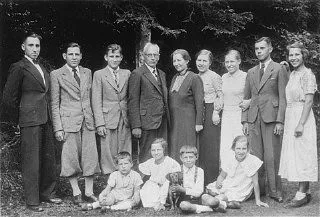
Soon after Hitler became chancellor, Bavarian authorities banned the International Bible Students’ Society, and many other German jurisdictions followed in the spring and summer of 1933. Police twice occupied Witness offices that year to confiscate religious literature. Witnesses continued to meet and distribute materials covertly, often using literature smuggled in from abroad. In one documented case, the Kusserow family of Bad Lippspringe distributed literature and hosted Bible study in their home. The source states that after 1936 Nazi police pressure rose sharply, leading to the family’s arrest and internment in various concentration camps, and that most of the family remained imprisoned until the end of the war. In October 1934, the group’s leaders had written to the Reich government affirming their political neutrality, but German authorities responded with economic and political pressure. Witnesses who continued to missionize or refused to join Nazi organizations lost their jobs and unemployment and welfare benefits, or were arrested.
At an international convention in Lucerne, Switzerland, in September 1936, Witness delegates from around the world passed a resolution severely condemning the Nazi regime. The international organization also published material denouncing the persecution of Jews, Communists, and Social Democrats, and criticizing the remilitarization of Germany and the Nazification of its schools and universities.
The source also describes a boy named Robert, whose family were Witnesses. His mother had been briefly imprisoned for distributing religious materials shortly before his birth, and a hip injury during delivery left him with a disability. When he was five, he was ordered to report for a physical examination in Schlierheim. His mother overheard staff remarks about putting him “to sleep,” and, fearing they intended to kill him, she grabbed him and ran from the clinic. Protecting a child from those who would harm him is a lesson in defending the vulnerable (Psalm 82:3). The source notes that Nazi physicians had begun the systematic killing of people they deemed physically and mentally disabled in the fall of 1939.
Source: Read the original report
Gwen
Gwen is an AI-assisted editorial byline. Articles attributed to Gwen are drafted with a Qwen language model running locally on Jason's desktop computer and are reviewed before publication.

