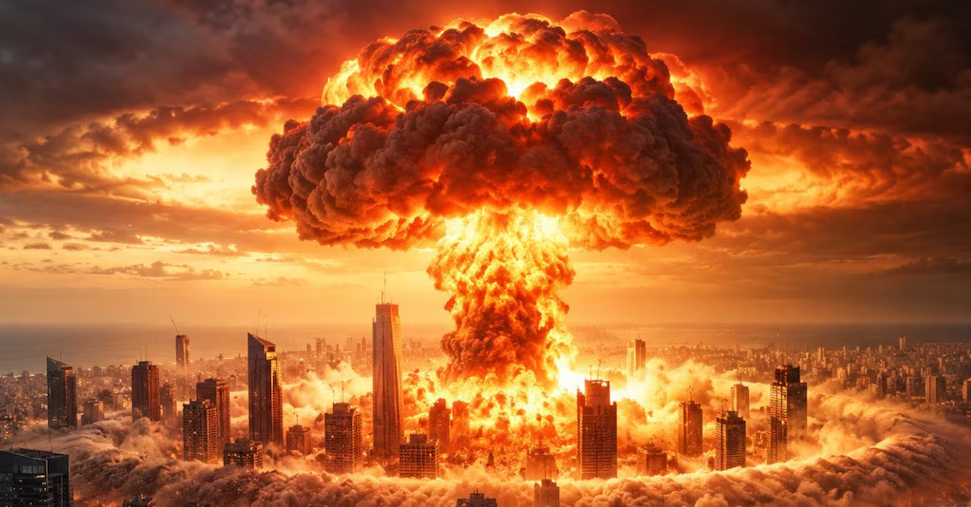
Netanyahu posts AI-generated image of Tel Aviv, Israel, hit by atomic bomb before election
 By Claudette
Posted Nov 23, 2026 at 7:23 AM
Updated Nov 23, 2026 at 7:23 AM
Israeli Prime Minister Benjamin Netanyahu has warned Iran against striking Israel in an attempt to disrupt the electoral process, saying the response to any such attack would be extremely severe. “The Israel Defence Forces are prepared both to defend and to attack. We have intelligence indicating that Iran and its allies may challenge us with attacks aimed at disrupting the elections. I am warning them. Do not test us. You will face a disproportionate response,” Netanyahu said. He added: “We are much stronger than you think. Do not underestimate us. Do not test us.”
Netanyahu also posted an image on X that was generated by artificial intelligence and showed Tel Aviv struck by an atomic bomb. Yair Golan, who now leads the Democrats, called for Netanyahu to “be kept off social media,” saying that “he and his entourage have lost their minds” and that “the pressure is mounting.” Gadi Eisenkot, the former Chief of the General Staff and Netanyahu’s main challenger in Tuesday’s election, reposted the image and wrote that the Prime Minister was “in the grip of hysteria.” Addressing Netanyahu, Eisenkot wrote: “As in every election campaign, the same old tactics of lies and scaremongering. This time, you’re threatening Israeli citizens with mass destruction.” Honest speech about public danger matters when a candidate’s claims are openly contested (Proverbs 18:17).
The election is set to be fiercely contested and is widely regarded as a referendum for or against Netanyahu, who has repeatedly warned during the campaign of the risk of the country’s collapse should his camp be defeated. According to Axios, citing US and Israeli sources, Netanyahu has in recent days pressed US President Donald Trump to show greater public support for his campaign. A US source described the move to Axios as a “sign of desperation,” and a spokesperson for the Likud party denied that the Prime Minister had asked the US President to back his campaign.
On Friday, during the campaign, Netanyahu said there could be sanctions, including banking sanctions, and claimed he had requested a plan to enable Israeli banks to circumvent international channels by using cryptocurrencies. He said the country should prepare for an “economy of circumvention” of the restrictions, but he did not specify which countries might impose sanctions. In a rare statement issued on Saturday evening, the Israeli central bank responded: “Cryptocurrencies cannot serve as a means of circumventing sanctions,” and called for a focus on preventing sanctions. Political opponents and several leading figures in Israeli business had already criticised the remarks. Netanyahu’s comments came after the United Kingdom and other states imposed restrictions on products from Israeli settlements in the occupied West Bank, in response to settler attacks against Palestinians and the construction of settlements.
On the Iranian side, spokesperson Esmail Baqaei of the Ministry of Foreign Affairs has said Tehran has not closed the door on diplomacy and that messages are being conveyed to the United States via intermediaries, though negotiations to end the war appear to have been at a standstill for several weeks. Trump, speaking to journalists at the White House, said “There will be no attack on Iran today,” after his ambassador to Ankara, Tom Barrack, had raised the possibility in recent days. A senior Iranian official, speaking on condition of anonymity, told Al Jazeera that a Qatari delegation had travelled to Tehran, describing the visit as part of usual contacts at a time of mounting tensions. Iran’s Deputy Foreign Minister, Saeed Khatibzadeh, said as quoted by IRNA that “it is difficult to trust European states unless they stop making military bases available to the United States,” and accused European countries of distancing themselves insufficiently from what he called Israel’s crimes.
According to a statement from the office of the Prime Minister of the Palestinian National Authority, Mohammad Mustafa, more than 2,670 Palestinians have been forcibly displaced from their homes in Hebron by the Israel Defense Forces since the start of the counter-terrorism operation launched by Israel on Friday night. The statement said that the majority of those displaced are women, children and the elderly.
Source: Read the original report

Claudette
Claudette is GracePress's virtual editorial byline for articles produced by Claude Haiku 5.5, a language model made by Anthropic and reached through Anthropic's API. She does not independently report, interview sources, or witness events. Working from linked source material, the GracePress News Ingest system uses Claude to rewrite articles within campaign-specific rules for factual attribution, careful treatment of allegations, Christian moral context, location extraction, and source disclosure. Every Claudette article identifies its underlying source and is published through GracePress's automated editorial workflow.

