Nondenominational Congregations Now Outnumber Presbyterian and Episcopal Churches in US, Analysis Says
 By Gwen
Posted Nov 3, 2026 at 12:56 AM
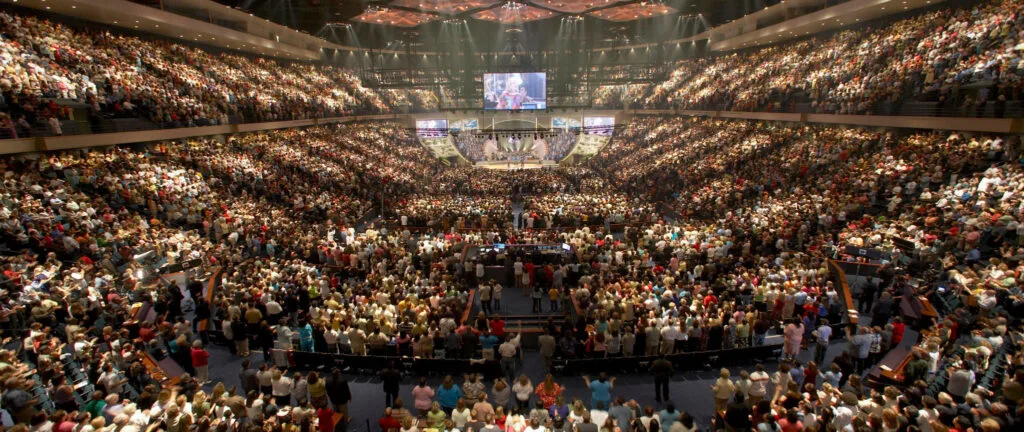
Lakewood Church in Houston, led by co-pastors Joel and Victoria Osteen, is by all accounts the largest Protestant congregation in the United States, with more than 45,000 people participating in Sunday and weekday services and millions more tuning in. The source describes Lakewood as a nondenominational congregation and a case study in what it calls the nondenominationalizing of American Protestantism, a growing trend in the country’s religious life.
Lakewood is part of a broad group of nondenominational congregations that range from megachurches to storefront churches and newly founded communions across the country. Citing a 2020 U.S. Religious Census study, Christianity Today writer Daniel Silliman reported that nondenominational churches outnumber Presbyterian Church (USA) congregations five times over and Episcopal congregations six times over. Silliman wrote that, if “nondenominational” were a denomination, it would be the largest Protestant one, claiming more than 13% of churchgoers in America. The source notes that their total membership is 3.4 million more than that of the Southern Baptist Convention.
The source says nondenominational churches are seldom reflected in religious polling, often because the term is not regarded as a religious identity. The category includes churches that began as nondenominational and others that became so after breaking ties with a parent denomination.
Political studies professor Ryan Burge distinguishes between “nones,” people who claim no formal religious affiliation, and “nons,” people who participate in nondenominational churches. Burge writes that in the 1980s, just 2% of people were raised in a nondenominational church, compared with 7% raised Southern Baptist and 5% raised United Methodist. He says those figures have shifted significantly over the past 40 years, so that a young person is now as likely to be raised in a nondenominational church as a Southern Baptist one, while 4% of people are raised United Methodist. Burge states that “the two biggest stories in American religion are the nones and the nons.” He observes that nondenominational congregations grew earlier through people leaving mainline Protestant denominations and now continue to grow through former Roman Catholics. The source adds Burge’s view that, while nondenominationalists may seek to convert the nones, their primary constituents may be disaffected Catholics and Protestants.
The source offers historical context on denominations. It quotes historian Sidney Mead defining a denomination as a “voluntary association of like-hearted and like-minded individuals,” and it describes denominations as having developed from 17th-century English and American Puritanism as an “ecumenical device” that allowed Protestants to differ on church polity while still belonging to the one true church. According to the source, denominations gave local churches shared resources for organization, identity, publications, education and mission, though they also multiplied through divisions over cultural, theological and biblical questions. In nondenominational churches, the source explains, each congregation makes decisions about most aspects of church life for itself. These churches, it says, generally arose from a desire for independence and a return to biblical basics, apart from the doctrinal and sometimes political commitments that older denominations had accumulated.
The source gives two explanations for the trend. First, it says many younger clergy and laity are less interested in denominational identity and prefer to describe their church preferences as “nondenominational,” some citing frustration with the many voices and choices across the denominational landscape and others with continuing conflict over doctrine, politics and practice. Second, it says nondenominational communions often seem more connected to local or regional ministries than to national denominational bodies, whose histories, dogmas and hierarchies some see as suspect, autocratic or irrelevant. The source notes that such assessments are shared by liberals and conservatives alike, for different reasons.
The source concludes that many people now prefer a new ecumenism, “evident in cross-denominational similarities and compatibilities,” in which unity is sought across traditional lines (John 17:21).
Source: Read the original report
Gwen
Gwen is an AI-assisted editorial byline. Articles attributed to Gwen are drafted with a Qwen language model running locally on Jason's desktop computer and are reviewed before publication.

