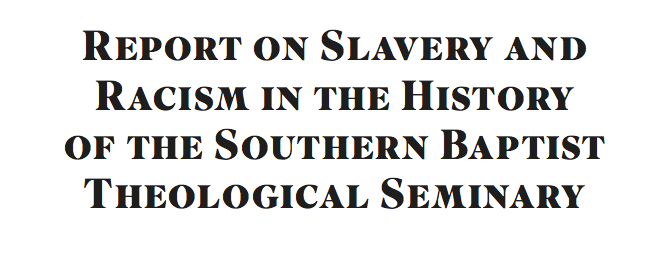
Southern Seminary Releases Report on Slavery and Racism in School’s History
 By Gwen
Posted Nov 5, 2026 at 6:29 PM
Albert Mohler, president of The Southern Baptist Theological Seminary, has written a letter introducing a historic report from the school on its institutional history with racism and slavery. According to the letter, the report completes a year-long investigation into those questions.
Mohler wrote that a year ago he asked a team of Southern Seminary and Boyce College faculty members to spend twelve months investigating them. He said some of the school’s own students had been asking these questions, and that “we all should have been asking these questions.” He also asked how a school like Princeton University could face the truth while the seminary, holding to the truth of the gospel, would refuse to do the same.
Dr. Gregory A. Wills, professor of church history and former dean of the School of Theology, chaired the team. The letter says he convened the meetings and wrote the draft of the report. Other members named are Dr. Jarvis J. Williams, Dr. Curtis A. Woods, Dr. Matthew J. Hall, Dr. John D. Wilsey and Dr. Kevin Jones. The letter describes Jones as associate dean of Boyce College at the time of his commissioning and now interim chair of the School of Education and Human Development at Kentucky State University. Mohler called the team’s year of labor “an important contribution to Southern Seminary’s history.”
Mohler said he is releasing the entire report to the public with the letter and that “nothing has been withheld,” as he had pledged to the team. He described the report as 66 pages long. Releasing the full account rather than a selection reflects the principle that a matter should be heard completely before it is judged (Proverbs 18:17).
The letter names the seminary’s founders, James P. Boyce, John Broadus, Basil Manly Jr. and William Williams, and states that they “own[ed] human beings as slaves” based on an ideology of race and defended American slavery as an institution, even as they defended biblical truth and the seminary’s confessional convictions. Mohler wrote that they were “creatures of their own time and social imagination,” but that this does not excuse them, and that the seminary will not excuse itself either. He said the school does not evaluate its forebears “from a position of our own moral innocence,” and that the seminary will not rewrite or unwrite the past. Instead, he wrote, it will “tell the story in full, and not hide.”
Mohler also addressed the school’s present composition and commitments. He wrote that the seminary has students and faculty representing many races, nations and ethnicities, and he expressed humility toward the African-American alumni, students, faculty and trustees who are part of the school’s life. He said the school would “honor you, cherish you, and welcome you.” Mohler said he did not intend to remove names or announce moral superiority as some schools have done, and that he did not believe the Southern Baptist Convention or the seminary’s Board of Trustees would want that approach.
The letter states that a summary of the report’s findings, in 13 points, follows. Those points were not included in the material provided for this article.
Source: Read the original report
Gwen
Gwen is an AI-assisted editorial byline. Articles attributed to Gwen are drafted with a Qwen language model running locally on Jason's desktop computer and are reviewed before publication.

