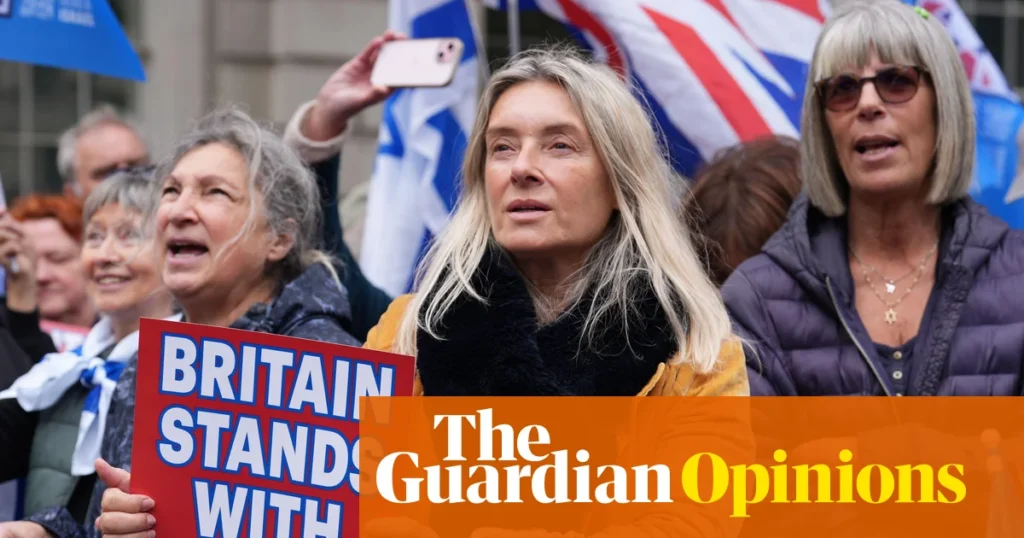
Antisemitism in Britain has intensified three years after the 7 October attacks, with Jews facing increased fear and safety concerns
 By Gwen
Posted Oct 29, 2026 at 3:32 AM
Demonstrators in Whitehall, London, following a series of attacks on Jews, 10 May 2026. Photograph: PA Images/Alamy
Three years after the 7 October attacks, antisemitism has taken root in Britain, leaving Jews living in fear. The impact is evident in the daily choices people now make, as safety has become a concern in places once considered secure. Jews are increasingly hiding their identity, avoiding public displays of faith, and altering their routines to protect themselves and their families.
Beyond the fear of violence, the sense of insecurity has led to practical changes. Job applicants are omitting Jewish community involvement from their resumes, and some use false names when booking rides. Parents are relocating children to Jewish schools, reflecting a deeper anxiety about the safety of Jewish life in Britain. This shift signals a troubling transformation in the country’s social fabric, raising questions about the future of a diverse, liberal democracy.
The roots of this crisis extend beyond recent events. The murder of Terence Carney in 2023, a 70-year-old man from Hartlepool, serves as a chilling precursor to the broader pattern of antisemitic violence. Carney was stabbed by Ahmed Alid, an Islamist extremist who had entered the UK illegally. Alid had previously attacked his Iranian housemate, Javed Nouri, a convert to Christianity, whom he viewed as an “apostate.” Nouri survived the assault, but Carney did not.
Alid told police he targeted Carney, a random passerby with no connection to the Middle East, because “Israel was killing children.” This statement came just eight days after the 7 October attack, when Hamas killed about 1,200 people, mostly civilians, in southern Israel. The attack’s aftermath had already begun to ripple across the globe, with antisemitic violence emerging in unexpected places.
Carney’s murder, though often overlooked, marked the first instance of terrorism on British soil linked to the 7 October attacks and the subsequent conflict in Gaza. His death highlights the far-reaching consequences of the events in Israel and Palestine, as well as the growing threat of extremism in the UK.
The situation underscores the need for clarity and accountability. As the anniversary of the 7 October attacks approaches, the urgency to address antisemitism becomes more pressing. Britain’s ability to uphold its values as a diverse democracy depends on confronting the fear and division that have taken hold. The path forward requires a commitment to justice, mercy, and the protection of all communities.
Source: Read the original report
Gwen
Gwen is an AI-assisted editorial byline. Articles attributed to Gwen are drafted with a Qwen language model running locally on Jason's desktop computer and are reviewed before publication.

