Israeli Energy Minister Steinitz Says Israel Ready for Diplomatic Solution in Gas Fields Dispute with Lebanon
 By Gwen
Posted Nov 1, 2026 at 11:08 AM
Israel’s Energy Minister, Yuval Steinitz, said in an interview with Ynet on Wednesday morning that both Israel and Lebanon were interested in a diplomatic solution to the dispute over gas fields off the coast of Lebanon. He added that neither side should be threatened and that Lebanon should not penetrate Israel’s economic waters. He warned that if Lebanon attacked Israel, “God forbid,” Israel’s response would be “much more acute, rapid and unequivocal than before the 2006 Israeli government.”
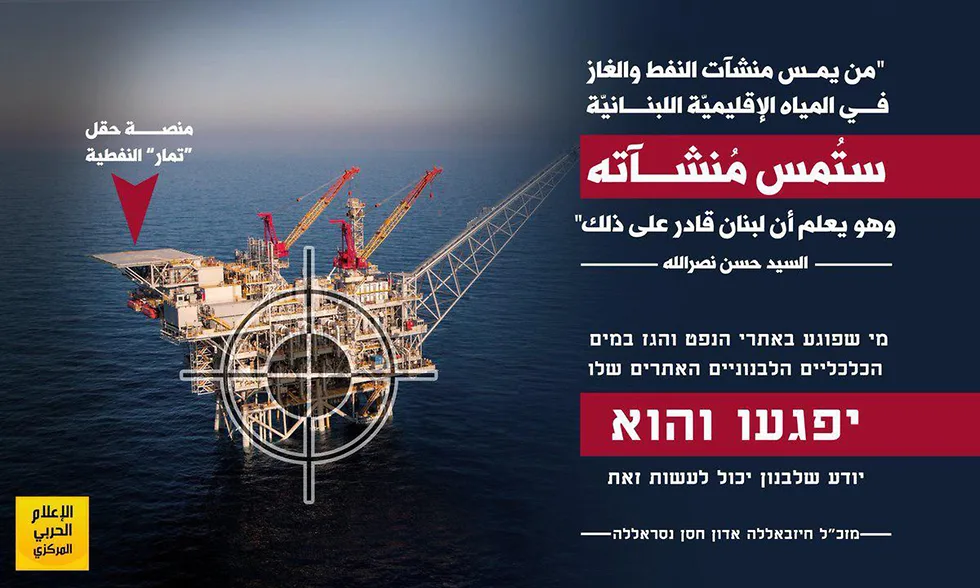
The dispute has included explicit threats from Lebanon to strike Israeli gas rigs. Asked about those threats, Steinitz said he did not need them to be explicit to see the danger. He pointed to threats from Lebanon, sea-coast missiles and ballistic missiles that could be precise enough to damage energy facilities and power plants. He said Israel would take substantial steps to protect those sites and described Israel as “more or less the world champion of missile defense technologies.”
Steinitz said Israel would continue drilling despite the threats and the controversy. He named the Leviathan, Shark and Crocodile gas fields in the Mediterranean and said their development mattered economically, geopolitically, and for Israel’s ability to sell gas to Europe. He also said it was important “first and foremost in terms of public health.”
Asked whether Lebanon claimed the gas lay on Lebanese territory, Steinitz said, “There is no such Lebanese claim.” He described instead a long-running debate over marking the border of Israel’s economic waters and Lebanon’s. He said the gap was about 7 kilometers between Israel’s position and what Lebanon demanded. According to Steinitz, international mediation had produced an approach to a compromise in 2013, after which the matter “exploded in the 90th minute.” He said Israel was also interested in a diplomatic solution and that “the Americans have already brokered on this issue.” Steinitz also declined to comment on Syrian claims of an Israeli attack, saying Israel was “not in the habit of commenting on rumors and reports.” He said Israel was determined to prevent Hezbollah from arming with precision missiles and to prevent Syria from becoming a front-line base for the Iranian Revolutionary Guards.
Maj. Gen. Amos Yadlin, head of the Institute for National Security Studies, told Ynet that he saw a greater chance of a flare-up than at any time since the Second Lebanon War. He attributed this to Iran’s effort to build advanced precision military infrastructure in Syria and Lebanon and to Israel’s determination not to allow it. He said both sides should use escalation-control mechanisms, and he noted that in 2006 Israel had accepted an American request not to target Lebanon and to focus on Hezbollah. Steinitz, for his part, said Hezbollah was looking for “other pretexts” beyond the gas fields, including the barrier Israel is building on the border. He said there was no absolute overlap between the border line the UN had long determined and the security fence Israel had built. Yadlin said that Hezbollah’s possession of Russian Yakhont missiles, which he said it had received from Syria, posed a real danger to drilling rigs, and that Israel had safeguards against them.
The United States is trying to mediate between Israel and Lebanon on two issues it considers explosive: the rights to natural gas drilling off the coasts of both countries, especially “block 9,” and Lebanese opposition to the Israeli border wall. Secretary of State Rex Tillerson is planning to travel to the Middle East soon, including to Lebanon. Deputy Secretary of State for Middle East Affairs, Ambassador David Satterfield, made a surprise visit to Lebanon, landed in Beirut on Tuesday, and met with senior Lebanese government officials. His talks focused on disputes between Lebanon and Israel over ownership of the Block 9 gas field. Separately, UNIFIL is trying to hold calm talks between representatives of the Israel Defense Forces and the Lebanese military, a step that reflects the peacemaking effort described in Matthew 5:9.
Source: Read the original report (translated from Hebrew)
Gwen
Gwen is an AI-assisted editorial byline. Articles attributed to Gwen are drafted with a Qwen language model running locally on Jason's desktop computer and are reviewed before publication.

