New Washington law requires cities to allow transitional and permanent supportive housing in residential zones
 By Gwen
Posted Nov 5, 2026 at 6:02 PM
A new Washington state law will require local governments to allow housing for people experiencing homelessness in residential areas. Communities across the state have pushed back, to varying degrees, against permitting homeless shelters and permanent supportive housing in their neighborhoods.
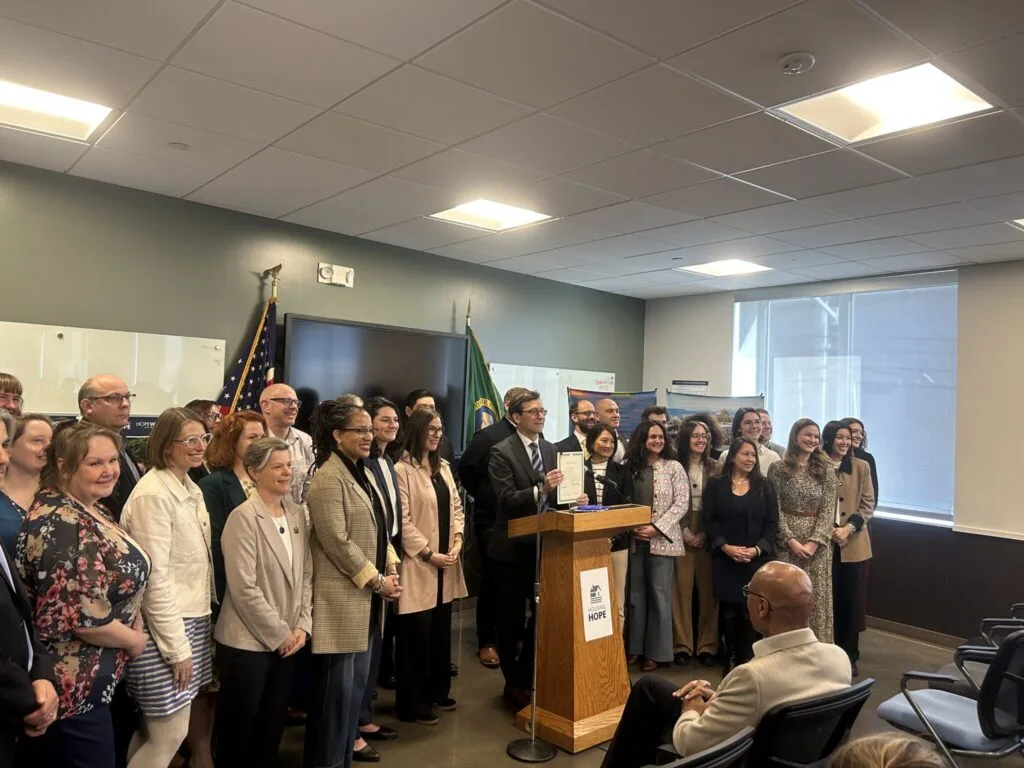
House Bill 2266, which Gov. Bob Ferguson signed Friday, limits local governments’ ability to stop these projects. Ferguson signed it, along with a slew of other housing-related bills, at HopeWorks Station, an affordable housing complex in Everett. Permanent supportive housing helps people with disabilities obtain stable housing and resources, while transitional housing provides temporary help before people move into something more permanent.
Sponsored by Rep. Strom Peterson, D-Edmonds, the bill requires cities to allow transitional and permanent supportive housing in residential and hotel development zones within an urban growth area. Indoor emergency shelters and housing must be allowed in zones where hotels are allowed. Under a 2021 law, cities cannot block permanent supportive housing in residential zones, or shelters in areas with hotels.
Local governments subject to the new requirement cannot impose conditions on so-called “STEP housing” that are more restrictive than those for other development. The mandates they can impose on affordable housing providers are limited to income qualification, coordinated entry, reporting and monitoring. Counties and cities may require prospective operators of indoor emergency shelters or housing to hold a community meeting, notify local residents and provide further information. If a shelter will be within 500 feet of a school, a local government can negotiate additional “reasonable requirements” related to health and safety for the site.
Majority Democrats in the Legislature pushed the measure through with no Republican votes. Backers hope the law, which takes effect in June, will minimize costly delays caused by local government apprehension. Ferguson said the law “ensures that STEP housing can be built more quickly and predictably.”
“Expanding it is an important step to ensuring more residents have a safe place to call home,” he said.
Lt. Gov. Denny Heck, who has been a key adviser to Ferguson on housing, called the law a “strong step forward.” “It was a moral failing of our state that our laws did not encourage and facilitate more construction of permanent supported housing,” Heck said. He also requested legislation to bar cities and counties from excluding residential development in commercial or mixed-use zones. Backers have pointed to strip malls and vacant properties as ripe for housing construction under the new policy. Sen. Emily Alvarado, D-Seattle, the bill’s sponsor, said, “We have a glut of vacant storefronts, of boarded up big box stores and of empty strip malls, and it would be amazing to help solve our housing shortage by transforming those places into homes.”
Other bills signed Friday require landlords to notify renters about flood risks for their units and allow detached accessory dwelling units outside urban growth areas. Another gives local governments more flexibility in how they use tax dollars for affordable housing, including, for example, funding the maintenance and operations of existing buildings. One controversial bill to keep cities and counties from criminalizing camping on public property did not make it to the finish line this year.
On funding, lawmakers earmarked another $200 million for housing and homelessness in the state’s construction budget. That includes $123 million for the Housing Trust Fund, the state’s primary source of funding for building affordable housing.
Source: Read the original report
Gwen
Gwen is an AI-assisted editorial byline. Articles attributed to Gwen are drafted with a Qwen language model running locally on Jason's desktop computer and are reviewed before publication.

