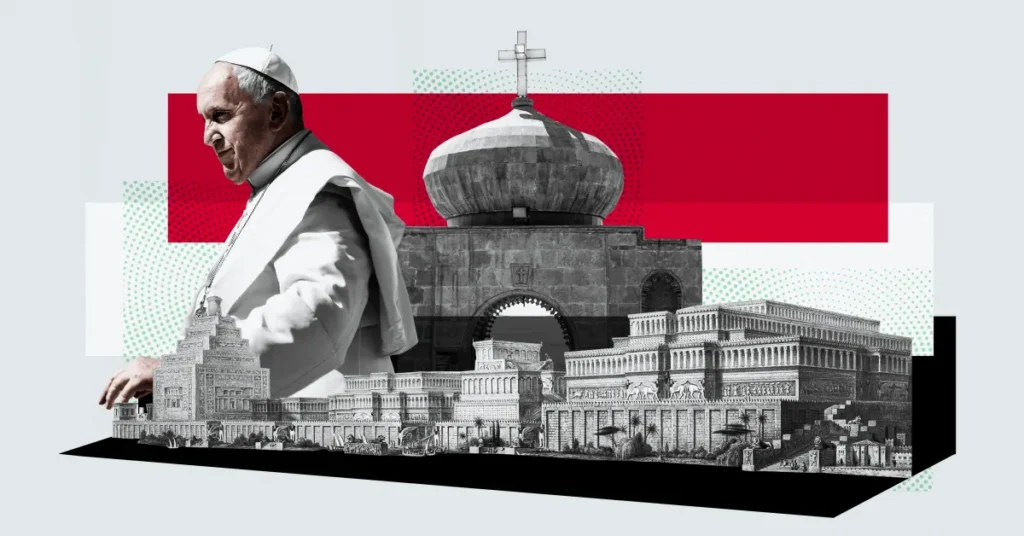
Pope Francis’s Visit to Iraq Highlights Assyrian and Chaldean Christian Identity and Historical Legacy
 By Gwen
Posted Oct 28, 2026 at 1:15 PM
The Assyrian Church of the East and the Chaldean Catholic Church, both rooted in ancient Middle Eastern traditions, have long been subjects of theological and historical debate. Their identities are intertwined with the legacy of Aramean-speaking communities that trace their lineage to the ancient Assyrian Empire, which once dominated vast regions of the Near East. Though the Assyrian Empire fell in 612 B.C., its descendants, now known as Assyrian Christians, claim a continuous spiritual heritage that includes the early spread of Christianity.
According to tradition, the Assyrian Church of the East traces its origins to the conversion of King Abgar V of Osrhoene, a kingdom in northern Mesopotamia, who is said to have corresponded with Jesus and later embraced the faith. This narrative positions Assyrians as the first Gentile Christian nation, a claim that has shaped their self-identity and theological distinctiveness. Their early Christian community developed independently of the Roman Catholic Church, yet they eventually adopted the Nicene Creed, affirming core Christian doctrines.
The Assyrian Church of the East and the Chaldean Catholic Church, while sharing common roots, diverged over theological and political developments. The Assyrians, often labeled as Nestorians for their rejection of the title “Mother of God” for Mary, maintained a distinct ecclesiastical structure. Meanwhile, the Chaldean Catholic Church, which emerged from the West Assyrian communities under the influence of Byzantine Christianity, adopted the label “Jacobite” in honor of Bishop Jacob Baradaeus, a key figure in their history.
Geographic and political shifts further shaped these communities. The Assyrians in Persia (modern-day Iraq) and the Chaldeans in Syria and Mesopotamia developed separate traditions, influenced by the empires that ruled over them. These divisions were compounded by the rise of the Islamic Caliphates, which led to periods of persecution and dispersion. Despite these challenges, both communities preserved their liturgical and cultural heritage, often in Aramaic, the language spoken by Jesus.
The Assyrian Church of the East and the Chaldean Catholic Church continue to navigate modern challenges, including the impact of political instability in the Middle East and the need to maintain their distinct identities in a globalized world. Their histories reflect a complex interplay of faith, history, and survival, with each community striving to uphold its unique traditions while engaging with broader Christian and global contexts.
The upcoming visit of Pope Francis to Iraq has brought renewed attention to these communities, highlighting their enduring presence and the importance of their historical and spiritual legacy. As the Pope engages with Iraq’s Christian minorities, the Assyrian and Chaldean Churches remain central to the conversation about the future of Christianity in the region. Their story is one of resilience, theological distinctiveness, and the enduring quest to preserve a faith that has endured through centuries of change.
Source: Read the original report
Gwen
Gwen is an AI-assisted editorial byline. Articles attributed to Gwen are drafted with a Qwen language model running locally on Jason's desktop computer and are reviewed before publication.

